Chapter 21 — Government Macroeconomic Policy Objectives
Cambridge International AS & A Level Economics (9708) · Unit 5.1 · 4th edition coursebook
Learning objectives
- Explain a government's macroeconomic policy objective of price stability.
- Explain a government's macroeconomic policy objective of low unemployment.
- Explain a government's macroeconomic policy objective of economic growth.
Key terms
- inflation target
- The inflation rate a central bank is set to achieve.
21.1Price stability
Governments seek to achieve price stability, by which is meant a low and stable rate of inflation rather than a zero rate. A zero target is generally avoided for three connected reasons. First, any measure of inflation tends to overstate the actual rise in prices, so a recorded figure close to zero may already represent falling prices. Second, aiming for zero risks tipping the economy into deflation. Third, a low and stable rise in prices caused by higher spending is likely to encourage firms to expand output, because gently rising prices signal stronger demand.
An increasing number of governments now set an inflation target for their central banks to achieve. Some governments choose a target range, while others choose a central target with a margin of permitted deviation on either side. Setting an explicit target serves two purposes. It makes the central bank more accountable, because its performance can be measured directly against the published number. It may also reduce inflationary expectations: if firms, workers and households have confidence in the central bank's ability to meet its target, they may act in a way that does not push prices up. Workers, for example, may not press for large wage rises if they expect future prices to remain stable.
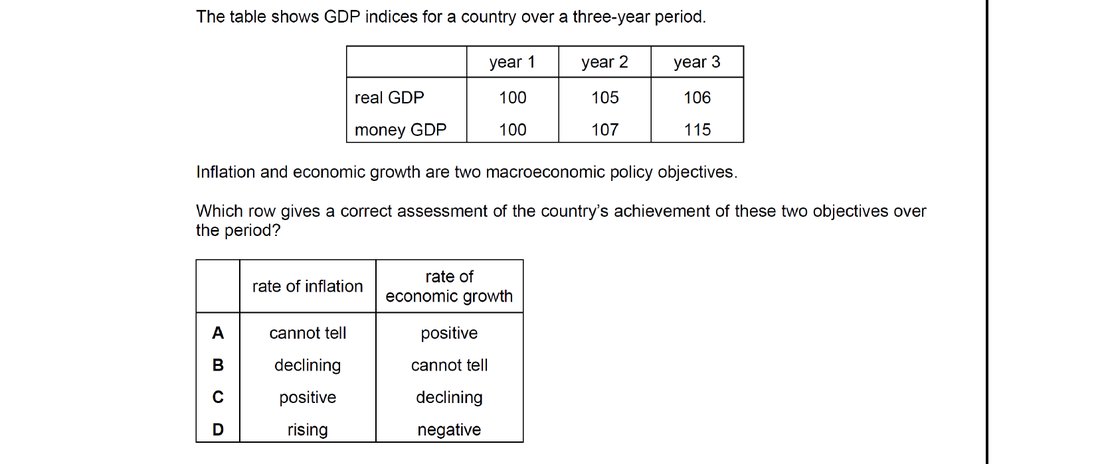
Real GDP rises from 100 to 105 (5%) then to 106 (~1%), so real growth is positive but slowing — growth is declining. Money GDP grows faster than real GDP in both years (107 vs 105, then 115 vs 106), so the price level is rising — inflation is positive. The correct row is therefore positive inflation with declining growth.
21.2Low unemployment
A low proportion of the labour force being unemployed brings a number of advantages to an economy. Output is higher because more of the workforce is producing goods and services. Tax revenue is higher because more people are earning incomes and spending. Government expenditure on unemployment benefit is lower, freeing public funds for other uses. For these reasons, low unemployment is a standard macroeconomic policy objective.
Governments also try to ensure that any unemployment that does occur is short term. If workers are out of work for long periods, they can lose their skills and their habits of work, which makes them harder to re-employ and weakens the economy's productive capacity. Policy responses to this risk usually involve promoting labour mobility — for example through training schemes that retrain displaced workers for occupations in which vacancies exist.
A government may also be concerned with the quality of employment, not only its quantity. The effect of low unemployment on the economy and on workers themselves may not be very beneficial if the jobs available are unskilled, insecure and low-paid. A high employment rate built on low-quality work tends to yield less tax revenue, less consumer spending power, and less long-term productivity growth than one built on skilled, secure work.
21.3Economic growth
Governments do not want their economies to grow too slowly, and they certainly do not want to experience negative economic growth. If a country's output is falling, unemployment may rise as firms cut back on production, and with fewer goods and services available, living standards may decline.
At the same time, governments want to avoid too high a rate of economic growth. An economy that grows too quickly can overheat, with aggregate demand increasing faster than aggregate supply. Pressure is then placed on resources, and inflationary pressure can build up. Entrepreneurs may become over-optimistic about future demand and set up firms that do not have a long-term future. Households may come to expect their incomes to continue rising at a high rate, which can encourage them to take out loans that they will struggle to repay if their expectations turn out to be wrong.
In judging what would be a good growth rate, a government takes into account several factors. These include changes in the size of the labour force, changes in productivity, and advances in technology. A growth rate that is sustainable for one economy may not be sustainable for another with a slower-growing labour force or weaker productivity gains.
Key concept link — Equilibrium and disequilibrium
Equilibrium and disequilibrium are important when assessing an economy's initial macroeconomic position. If an economy is in macroeconomic equilibrium below full capacity, it is not being productively efficient.
End-of-chapter practice
Past-paper questions from CIE 9708. Pick A, B, C or D. Answers are saved on this device — press Download report (PDF) at the top to save them.
Attempt the practice questions above to build your score.
Self-evaluation checklist
After studying this chapter, you should be able to:
- Explain why governments use price stability as a macroeconomic policy objective.
- Explain why governments use low unemployment as a macroeconomic policy objective.
- Explain why governments use economic growth as a macroeconomic policy objective.
Want more practice? Drill this chapter's past-paper MCQs (3 questions) →